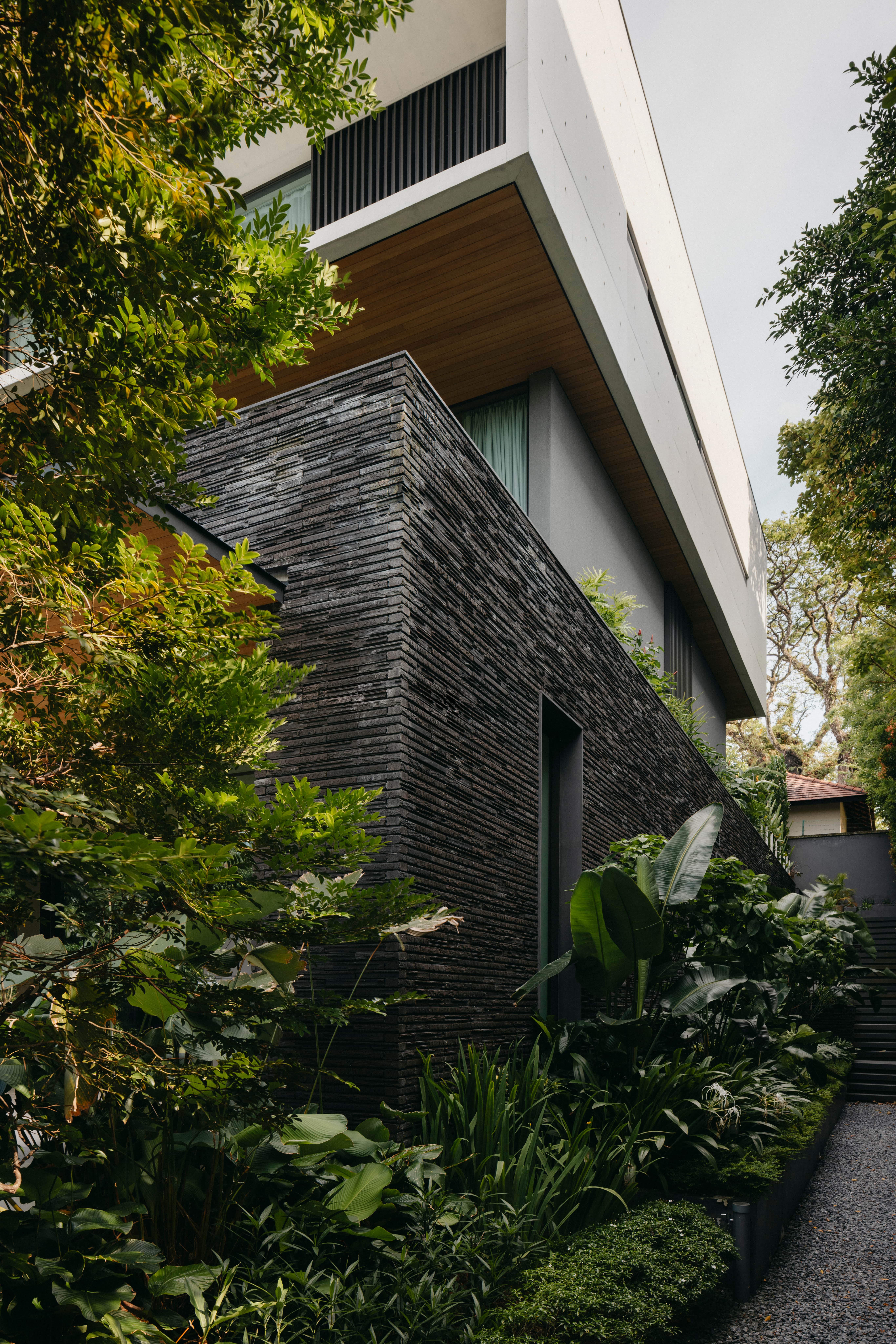
Set within the lush, high-landed enclave of Bukit Timah, the Sactum House is conceived as a contemporary tropical residence shaped by terrain, climate, and privacy.
The site presents a steep natural slope and a complex orientation. Rather than imposing a singular object onto the landscape, the design works with the topography, allowing the house to step gently with the land. The architecture is composed as a series of layered volumes, carefully positioned to open towards the garden while shielding neighbouring boundaries.
Arrival is choreographed as a gradual transition from street to home. A landscaped driveway leads to an elevated entrance plateau, lifting the house above the natural slope and creating a calm sense of arrival.
From here, a central foyer anchors the house, organising movement across the different levels.
The main living spaces are positioned on the garden level, where interior and exterior environments merge into a continuous social landscape.
Living, dining, and entertainment areas extend towards a long lawn and a twenty-metre lap pool, reinforcing a strong relationship between architecture and nature.
The pool deck is integrated directly into the garden, allowing outdoor living to remain open, flexible, and visually uninterrupted.
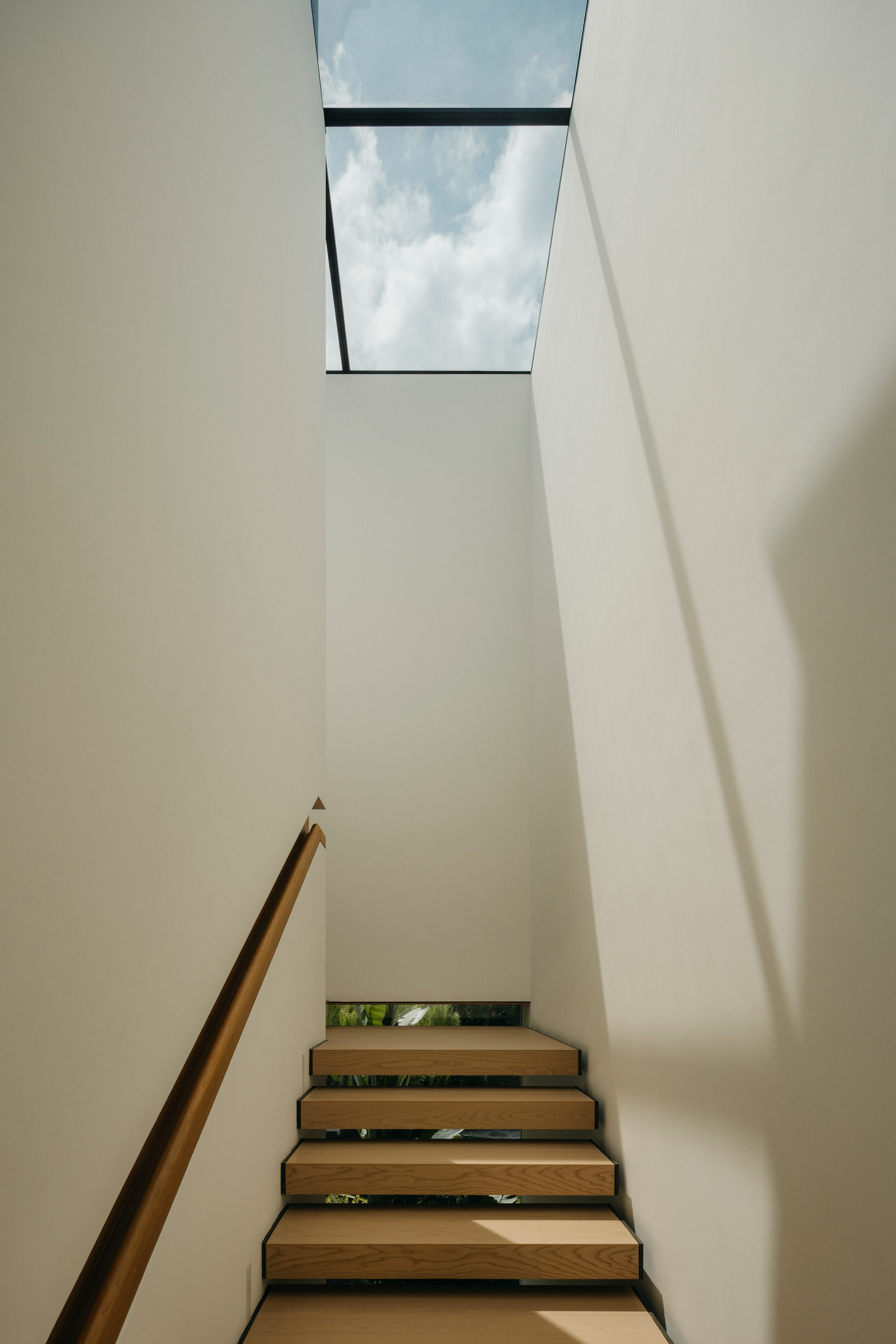
A centralised circulation core separates public and service zones while introducing a courtyard that draws daylight and natural ventilation deep into the house. The arrangement creates moments of openness within the plan while maintaining clarity and functional efficiency.
Private spaces are located on the upper level, where bedrooms are oriented along a north–south axis to optimise daylight and cross ventilation. Solid side elevations protect privacy from neighbouring houses, while openings are carefully directed towards greenery and distant views.
Environmental performance is embedded into the architectural form. The eastern and western facades are screened to reduce heat gain from the tropical sun. The massing encourages natural cross ventilation, capturing prevailing monsoon winds to cool the interior. Solar panels are integrated into the roof, improving energy efficiency while contributing to thermal insulation. The swimming pool is aligned with the sun path, allowing it to remain comfortably warm throughout the day.
The House is ultimately a study in balance — between architecture and landscape, privacy and openness, solidity and transparency. Through a restrained architectural language, the house creates a calm and enduring tropical home grounded in its site and climate.